
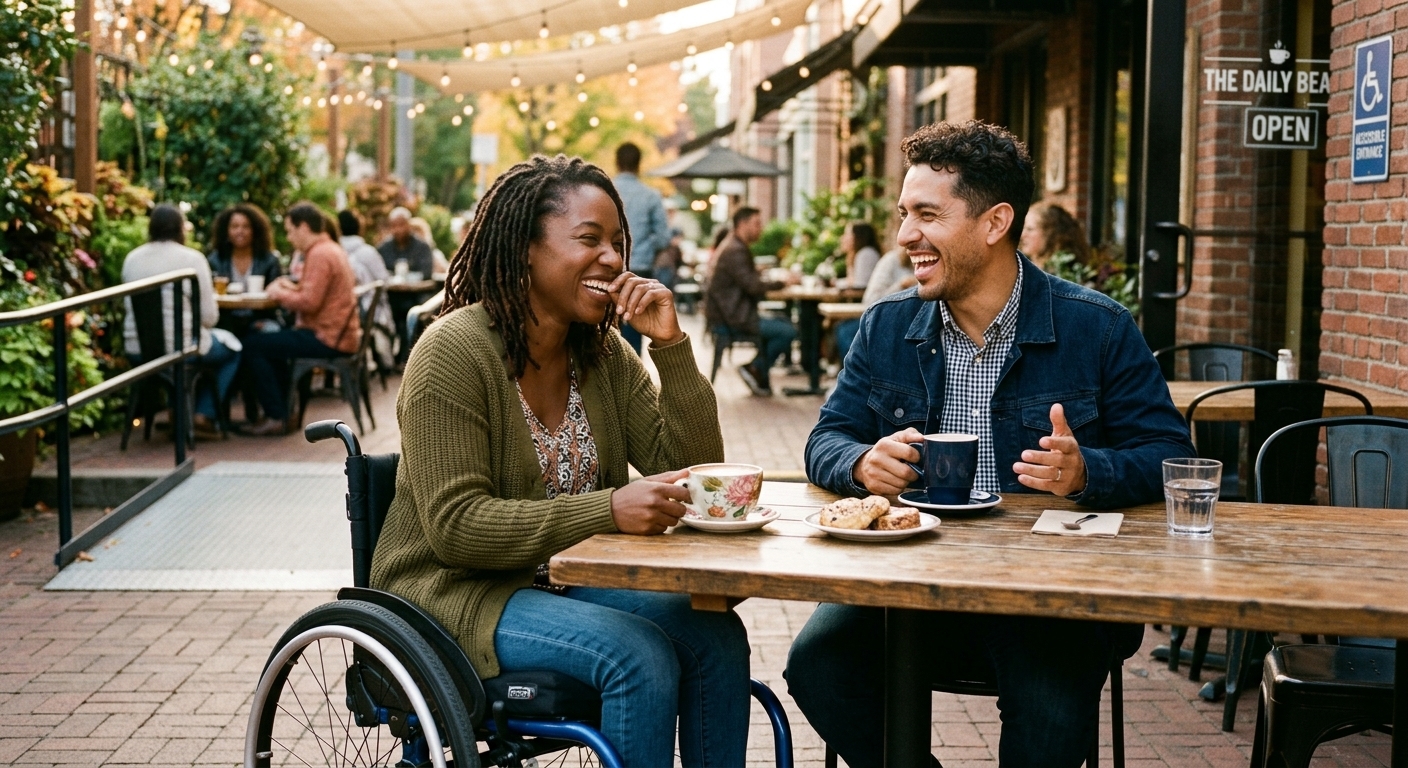
Dating is complicated for everyone. When you have a disability, it comes with an extra layer: questions about when to disclose, how to find accessible venues, whether to use a niche platform or a mainstream app, and how to navigate matches who simply do not understand your experience. This guide does not pretend those complications do not exist. Instead, it walks through each one practically, drawing on what actually works for disabled daters in the UK and US today.
Whether you use a wheelchair, live with a chronic illness, are deaf or hard-of-hearing, or are neurodivergent, the core challenges of dating remain the same: finding someone compatible, communicating clearly, and getting to know each other in a setting that works for both of you. This guide covers all of that.
What dating with a disability is actually like today
The short answer: better than it used to be, harder than it should be. Disabled people in the UK and US have more options than at any previous point. Niche platforms have grown substantially, mainstream apps have added disability-related prompts, and cultural attitudes have shifted, at least in parts of society. The dating pool for disabled singles is no longer as constrained as it was a decade ago.
That said, the experience varies enormously depending on the nature of your disability, how visible it is, and which platform you use. Disability charity Scope's attitudes research found that two thirds of the British public admit feeling uncomfortable talking to disabled people, and that awkwardness follows people onto the apps. Disabled daters routinely describe being unmatched or ghosted after mentioning their disability, and the exhaustion of having to educate every new match about their condition before a conversation can even begin.
The practical barriers are real too. First-date venues are often inaccessible. Transport to and from dates is harder to arrange. And the emotional labour of managing another person's awkwardness around disability, on top of the ordinary stress of dating, adds up quickly.
None of this means dating with a disability is not worth pursuing. It means going in with eyes open, choosing your platform and approach carefully, and giving yourself credit for navigating something that takes more effort than the dating advice industry typically acknowledges.
Why dating apps were built without disability in mind
Most mainstream dating apps were designed with a narrow set of assumptions baked in from the beginning: that users can swipe quickly with both hands, that profile photos are the primary signal, that the flow from match to message to date is fast and straightforward, and that accessibility is someone else's problem to solve later.
The result is platforms where disability is an afterthought. Photo-first design penalises disabled users who may use mobility aids or who feel their appearance will be judged through a medical lens before a conversation begins. Filter systems are built around age, location, and height, not around the things disabled daters actually need to know about a potential match. The messaging flow assumes real-time availability and a level of cognitive and physical ease that not everyone has.
When apps have added disability features, they have often done so tentatively. Hinge introduced a disability prompt, which lets users add disability status to their profile. It was a positive step, but it does not change the underlying structure of the platform. You can now signal that you are disabled, but you are still in a sea of users for whom disability is unfamiliar, and you are still relying on the other person's response to that signal to gauge compatibility.
The fundamental issue is that disability-inclusive design requires thinking about it at the foundation stage, not bolting it on as a feature. That is what a purpose-built disability dating platform can do, and what most general platforms cannot replicate through feature additions alone.
Niche disability dating sites vs mainstream apps
The choice between a disability-specific platform and a mainstream app is not binary. Many disabled daters use both. But understanding what each does well helps you make deliberate choices rather than defaulting to wherever everyone else is.
Niche platforms such as DisabilityMatch are built around a shared understanding. Every member knows that disability is part of the picture. That shifts the dynamic from the first message: you are not entering every conversation needing to explain yourself or manage someone else's reaction. The community is self-selecting. People who join a disability dating platform have already signalled that they are open to dating someone with a disability, whether or not they have one themselves.
DisabilityMatch has grown to over 40,000 members across the UK, US, Australia, Canada, and Ireland. It offers free Classic membership with full profile creation and daily match suggestions, VIP membership from £9.99 a month on a 12-month plan for unrestricted messaging, and free ID verification with a Blue Tick badge to help members distinguish genuine profiles from suspicious ones. The platform covers all disability types: physical, sensory, chronic illness, neurodivergent conditions, and mental health.
For a detailed look at how disability-specific platforms compare to mainstream alternatives, see our comparisons section, which covers DisabilityMatch against Hinge, Match.com, and other platforms.
Mainstream apps have one significant advantage: volume. Hinge, Tinder, Bumble, and Match.com collectively have hundreds of millions of users. If you live somewhere with a smaller disabled population, or if you want to meet both disabled and non-disabled partners, a mainstream app may give you more options in your area. The trade-off is that you will spend more time on disclosure conversations, and you will encounter more matches who have not previously thought about disability or accessibility.
The practical recommendation for most disabled daters: start with DisabilityMatch as your primary platform, and use a mainstream app as a secondary option if you want to broaden your pool. You can read more in our guide to the best dating apps for disabled people in the UK.
Writing your dating profile when you have a disability
Profile writing is where many disabled daters spend too much time on questions that do not have clean answers. How much do I say about my disability? Will mentioning it upfront put people off? Should my photos include my wheelchair or mobility aid?
The evidence from disabled daters consistently points in one direction: profiles that are honest about disability tend to attract better-quality matches. Hiding or minimising your disability to get more initial matches tends to increase the number of awkward disclosure conversations later, and the emotional cost of those conversations is high. Filtering at the profile stage is a feature, not a bug.
That does not mean your profile needs to be a medical summary. Disability is part of who you are, not the whole story. The most effective approach is to mention it clearly but proportionately, then spend the majority of your profile on your personality, interests, and what you are looking for in a relationship.
On photos, include at least one image that shows you as you actually look day to day. If you use a mobility aid and you never include it in photos, you are creating a gap between your profile and reality that will need to be managed every time you meet someone.
For a full walkthrough with specific examples, read our guide on how to write a disability dating profile.
The disclosure question: when to mention your disability
Disclosure is the topic disabled daters most frequently raise when they talk about the challenges of online dating. When is the right time? What is the right way? What if the reaction is bad?
There is no universal answer, because disability is not a uniform experience. A wheelchair user whose disability is visible from the first photo faces a different situation from someone with an autoimmune condition that is invisible in daily life. Someone with a stable, well-managed chronic condition is in a different position from someone whose disability significantly affects their daily routine.
That said, a few principles hold up across most situations. Disclosing on your profile, or in early messages before a first date, tends to reduce the emotional cost of the process overall. It filters out incompatible matches early. It gives you information about how a potential partner handles unexpected or unfamiliar situations, which is useful data. And it means that when you do meet, you can focus on getting to know each other rather than managing a revelation.
If your disability is invisible and you prefer to disclose in person, give yourself some guidance on when you will do it before you go on the date. Deciding on the spot is harder than having a loose plan.
Read the full guide on when to tell someone about your disability for a more detailed walk through the different scenarios.
First-date accessibility: what to ask, what to expect
Finding an accessible first-date venue sounds like it should be straightforward today. In practice, accessibility information online is still unreliable, venue staff are often unsure of their own facilities, and what counts as "accessible" varies widely.
The safest approach is to verify directly. Call or message the venue before booking. Specific questions get better answers than general ones. Instead of "are you accessible?", ask: "Is there step-free access from the street to the main seating area?" "Is there an accessible toilet on the same floor?" "Where is the nearest accessible parking?" "Is there a hearing loop?" Most venues will answer these questions honestly if asked specifically.
For wheelchair users in the UK, Blue Badge parking is widely available in city centres, but arrival and departure logistics still need planning. Many venues have accessible entrances that are not the main entrance: find out where it is before you arrive, so you are not navigating it for the first time with someone you have just met.
For deaf and hard-of-hearing daters, venue noise levels matter enormously. A busy bar on a Saturday night is a hostile environment for lipreading or for hearing aid users. A quieter cafe or restaurant early in the evening gives both people a much better chance of actually hearing each other. Do not feel awkward specifying this when you suggest a venue. "I find it easier somewhere quieter" is a completely normal preference to express.
For people with chronic illness or fatigue conditions, think about journey length as well as the venue itself. A short journey to a well-located place is less draining than a longer trip to somewhere theoretically nicer. And build in a graceful exit: it is perfectly fine to be honest with your date that you may need to leave at a certain time depending on how you feel. Most people find honesty like this reassuring rather than off-putting.
If a venue turns out not to be accessible when you arrive, it is reasonable to suggest moving. Having a backup option in mind beforehand means you are not scrambling on the night. Your date's reaction to an unexpected change of plan also tells you something useful about their flexibility and patience.
Dating with specific disability types
The challenges and strategies vary depending on the type of disability. The table below outlines the most common considerations.
| Disability type | Common dating challenges | Recommended platform | One-line accessibility tip |
|---|---|---|---|
| Wheelchair users | Inaccessible venues, transport logistics, assumptions about capability or desirability | DisabilityMatch (community that understands mobility needs; step-free venue questions are normal here) | Call the venue directly and ask for the accessible entrance location before you arrive. |
| Deaf and hard-of-hearing | High-noise venues, lipreading logistics, video call communication styles | DisabilityMatch (text-first messaging suits deaf communication styles; members understand) | Suggest a quiet venue early in the evening rather than a bar, and mention it as a preference rather than a need. |
| Blind and visually impaired | Photo-first app design, unfamiliar venue navigation, transport to and from dates | DisabilityMatch (profile depth beyond photos; community does not rely on photo-first judgements) | Ask your date to meet you at a landmark rather than a specific door, and agree a check-in message when you are close. |
| Chronic illness | Unpredictable symptoms, fatigue, needing to cancel or leave early | DisabilityMatch (matches already understand that plans may need flexibility) | Choose low-commitment first dates: coffee rather than dinner, so leaving early is natural rather than abrupt. |
| Neurodivergent conditions (autism, ADHD, dyslexia) | Social scripts that do not fit, sensory overload in busy venues, masking fatigue | DisabilityMatch (structured profile prompts reduce open-ended small talk anxiety; supportive community) | Agree in advance what the date will involve so there are no unexpected changes, and choose a venue with consistent low noise levels. |
| Mental health conditions | Stigma, timing of disclosure, energy management around social interaction | DisabilityMatch (reduced stigma within a disability-literate community; no need to explain from scratch) | Treat disclosure like any other disability: be honest at a level that feels right for the stage of the relationship, not all at once. |
Common myths about disabled dating, debunked
"Disabled people are only looking for other disabled people."
Not true. DisabilityMatch, like most disability dating platforms, has a mixed membership of disabled and non-disabled people. Many non-disabled members join specifically because they want to date within a community that understands and accepts disability. Others have a disabled family member and are already familiar with the issues involved. The platform is disability-inclusive, not disability-exclusive.
"Online dating is not really an option for disabled people because apps are not accessible."
Mainstream apps have accessibility gaps, but the situation has improved significantly and continues to do so. DisabilityMatch is designed with accessibility as a core requirement, not an afterthought. Screen reader compatibility, keyboard navigation, and text-first communication options are all considered. For many disabled people, online dating is actually more accessible than meeting people through traditional social settings, because it removes the physical environment barrier entirely from the early stages.
"You have to disclose everything about your disability immediately or it is dishonest."
Disclosure is a personal decision with no single correct timing. Mentioning your disability early tends to improve the quality of your matches, but there is no obligation to share every medical detail before you have even met someone. The level of detail that is appropriate grows naturally as a relationship develops, exactly as it does for any other personal information. What matters is that you do not misrepresent yourself in ways that would materially affect a potential partner's decision to meet you.
"Disability dating sites are a last resort for people who cannot find a partner elsewhere."
This reflects outdated thinking about niche platforms generally. Niche dating platforms exist across every imaginable group: shared religion, shared profession, shared dietary preferences. Choosing a platform where you are understood from the start is a strategic decision, not a concession. Many DisabilityMatch members have tried mainstream apps first and switched specifically because the quality of conversations was better in a community where disability is normal rather than exceptional.
A note for non-disabled readers
If you are non-disabled and reading this guide because you are open to dating someone with a disability, that openness matters and it is worth acting on. The most useful thing you can do is educate yourself before you start messaging. Read about the disability your potential match has mentioned. Ask questions that show genuine curiosity rather than awkwardness. Do not centre your own feelings about disability in conversations about theirs. And if you join a platform like DisabilityMatch, understand that you are entering a community built around disability as a normal part of life, not as something to be managed or overcome. Approach it with that understanding and you will do fine.
Practical first steps
If you have read this far, you are ready to start. Here is a simple starting point.
First, join DisabilityMatch free. Classic membership costs nothing and gives you a full profile, daily match suggestions, and the ability to browse over 40,000 members. You can upgrade to VIP from £9.99 a month on a 12-month plan if you want unrestricted messaging.
Second, read the profile writing guide before you complete your profile. The choices you make at the profile stage shape who reaches out to you and who does not. Getting it right early saves time later.
Third, do not let the first message stop you. The formula is simpler than it feels: mention something specific from their profile and end with a question that is easy to answer. If the words will not come, an app that writes dating openers such as SayMore can hand you three suggestions to edit into your own voice, and our guide on what to say on a dating app covers the rest.
Fourth, when you are ready to arrange a first date, spend five minutes checking venue accessibility before you suggest a location. One call or message to the venue is all it takes. It signals to your date that you are organised and considerate, and it means you can focus on each other rather than logistics once you are there.
Dating with a disability takes more planning than mainstream dating advice suggests. But the relationships it leads to are not different in kind from any other: they are built on connection, shared values, and the willingness of two people to show up for each other. That part is the same for everyone.
Join DisabilityMatch free today
Create your profile, browse over 40,000 members, and get daily match suggestions at no cost.
JoinFrequently asked questions
What is dating with a disability like?
Dating with a disability is more possible than ever, but mainstream platforms still present real challenges. Many disabled people report having to over-explain their conditions, dealing with matches who disappear after disclosure, or navigating inaccessible first-date venues. Niche platforms like DisabilityMatch reduce that friction by creating a community where disability is understood as part of who you are, not a complication to manage.
Are there free dating sites for people with disabilities?
Yes. DisabilityMatch offers a free Classic membership that lets you create a profile, browse other members, and receive daily match suggestions at no cost. Paid VIP membership (£24.95 a month, or £9.99 a month on a 12-month plan) unlocks unrestricted messaging and advanced features.
Should I mention my disability on my dating profile?
It depends on what feels right for you. Many disabled daters find that mentioning their disability on their profile attracts more compatible matches and filters out people who would struggle to accept it. Others prefer to disclose in conversation. There is no single right answer, but being open early tends to reduce the emotional cost of later disclosure.
What dating apps work best for wheelchair users?
DisabilityMatch is the most disability-inclusive option, with a community that understands accessibility needs from the start. On mainstream apps, Hinge added a disability prompt which makes it easier to signal openness to disabled partners. For first dates, the platform matters less than the venue: always check venue accessibility before suggesting a location.
How do I bring up disability on a first date?
If your disability is visible, it will likely come up naturally. If it is less visible, you can raise it when it feels relevant to the conversation, not as a confession but as context. Practical framing works well: mentioning that you will need a ground-floor venue, or that you may need to leave early if fatigue sets in, gives your date useful information without turning the meeting into a disclosure session.
Is online dating safe for people with disabilities?
Online dating carries the same general risks for disabled people as for anyone, with some additional considerations around vulnerability. DisabilityMatch uses free ID verification, AI behaviour monitoring, and 24/7 human support to reduce those risks. On any platform, take the standard precautions: meet in a public place, tell someone where you are going, and trust your instincts.
Read next: Disabled Dating: Mainstream Apps or a Specialist Site, our overview of how disabled people meet partners online and how to choose between mainstream apps and disability-specific platforms.